
I spent two years as board chair of a free clinic. I’ve sat in those waiting rooms. I’ve seen the woman who rationed her insulin for three months because she couldn’t afford a doctor’s visit. The man who knew something was wrong with his heart but had no way to get it checked. The mother who brought her child in for an ear infection that had been quietly progressing for weeks. These are not edge cases. They are the norm for the millions of Americans who fall through the gaps of our healthcare system — and after this year’s ACA enrollment collapse, that gap just got significantly wider.
More than a million fewer Americans enrolled in Affordable Care Act health plans for 2026 after enhanced federal subsidies expired at the end of last year. Average monthly premiums for subsidized enrollees jumped from $113 to $178. For those who lost subsidy eligibility entirely, total costs more than doubled. In states like North Carolina and Ohio, sign-ups fell by 20% or more. The CBO projected the lapse would leave 2.2 million more Americans uninsured this year alone, with the number growing in subsequent years. And the final toll may be worse — millions of auto-renewed policyholders are still receiving their first bills and quietly letting coverage lapse.
Washington has debated this as a budget question. It is not.
It is a health crisis unfolding in slow motion.
What the ER Already Knows
If you want to understand what’s coming, watch *The Pitt*. The Max drama — which has earned widespread praise from emergency physicians and nurses for its unflinching accuracy — captures something that policy papers rarely do: the emergency department as the de facto primary care system for the uninsured. Patients arrive having waited too long, having self-managed conditions that were once manageable and are now acute. The staff is overwhelmed, under-resourced, and absorbing not just medical crises but the cascading failures of a system that left people nowhere else to turn. Healthcare workers who’ve seen the show say it can feel like watching their own shift on screen. That discomfort is the point.
From my time on the clinic board, I can tell you that *The Pitt* isn’t dramatizing an exception. It’s depicting the rule.
The Quiet Spiral of Deferred Care
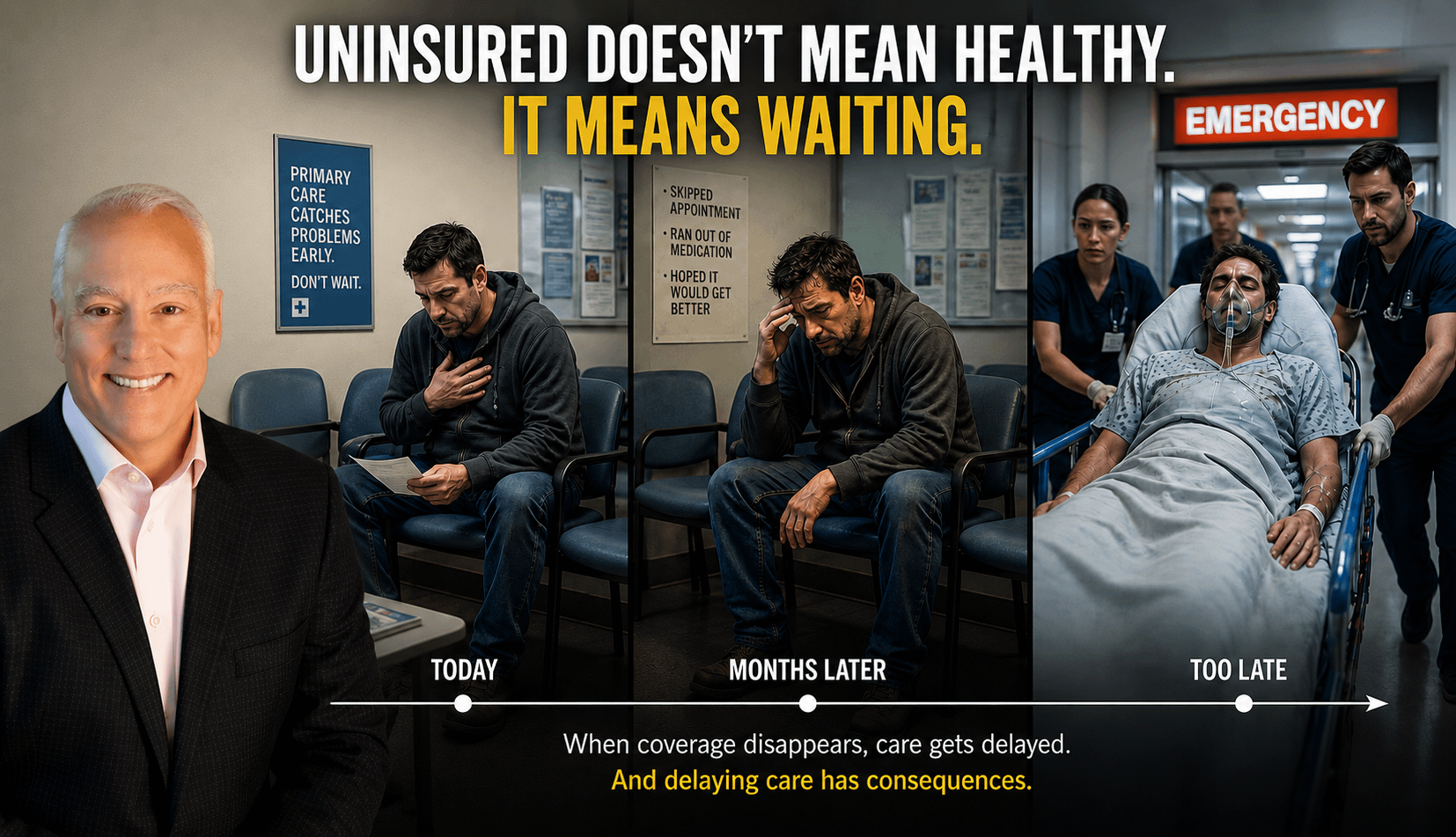
When people lose insurance, they don’t stop getting sick. They stop going to the doctor.
They skip the colonoscopy. They manage chest tightness with antacids and hope. They ration medication. They let the lump become something they’re “keeping an eye on.” And then, months later, they arrive by ambulance — sicker, more expensive to treat, and often out of time.
Decades of research confirm what clinic and ER workers already know firsthand: the uninsured delay care until manageable conditions become catastrophic. Diabetic patients without coverage are hospitalized at far higher rates. Uninsured cancer patients are diagnosed at later stages and die sooner. Preventable complications become irreversible ones.
The Costs We’re Not Counting
Proponents of letting the subsidies expire frame it as fiscal responsibility. The math doesn’t hold.
An ER visit for a condition that could have been managed in a clinic costs five to ten times more. Treating late-stage cancer costs multiples of what early detection and intervention would have. Preventable amputations, avoidable hospitalizations, untreated mental health crises — the bill lands on hospitals as uncompensated care, which gets absorbed into the system and passed along to everyone else as higher premiums and inflated charges. The savings from cutting subsidies are largely illusory. We are simply moving costs downstream, where they arrive larger and harder to address.
What You Can Do Right Now
If you’ve lost coverage or can’t afford it, you are not without options.
**Medicaid** remains available in most states for individuals and families below 138% of the federal poverty level. Check your eligibility at HealthCare.gov or your state’s Medicaid agency.
**Federally Qualified Health Centers (FQHCs)** provide care on a sliding-fee scale regardless of insurance status. Find one at findahealthcenter.hrsa.gov.
**Free and charitable clinics** serve most metropolitan and many rural areas. The National Association of Free & Charitable Clinics maintains a searchable directory at nafcclinics.org. These clinics are staffed by dedicated professionals — and are perpetually underfunded. If you can volunteer or donate, please do.
**Prescription assistance programs** through pharmaceutical manufacturers can dramatically reduce or eliminate medication costs. NeedyMeds.org and RxAssist.org are good starting points.
**Special Enrollment Periods** may still apply if you’ve had a qualifying life event — job loss, marriage, or a move. Call 1-800-318-2596 or visit HealthCare.gov.
Don’t wait until you are sick. Establish a relationship with a provider now.
What We Must Do Together
Individual resourcefulness cannot substitute for structural repair. On January 8, 2026, the U.S. House passed a three-year extension of enhanced Affordable Care Act (ACA) subsidies (230–196). The Senate must advance the House-passed three-year subsidy extension. That is the immediate, available fix.
But the deeper imperative is to stop treating health coverage as a partisan bargaining chip. Every coverage lapse is a delayed diagnosis, a preventable complication, a family bankrupted, a life cut short. Free clinics and emergency rooms are monuments to good intentions operating inside a broken architecture. The people staffing them — the doctors, nurses, and volunteers I’ve worked alongside — are extraordinary. They should not have to be.
The people who dropped their ACA plans this year are our neighbors, our coworkers, our parents. Some of them will show up in emergency rooms in the months ahead — sicker, more costly to treat, and running out of time. We will pay for that, one way or another. The only question is whether we pay wisely, by keeping people covered and connected to care, or expensively, by waiting until there is no other choice.
*The Pitt* already knows the answer. So do the people who’ve worked in those rooms. It’s time the rest of us caught up.
Anthony Cirillo has spent decades helping families, caregivers, and professionals rethink what aging can look like. A nationally respected voice in senior living and aging advocacy, Anthony brings insight, clarity, and compassion to conversations that matter. From navigating caregiving challenges to understanding the future of senior lifestyles, his perspective helps families make smarter, more confident decisions. If you care about aging well, supporting loved ones, or understanding the changing world of senior living, Anthony Cirillo is a voice worth hearing.